
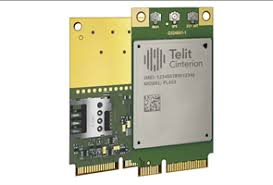
🔬 Optimized LTE Cat 1 Connectivity: Delivers IoT-optimized speeds of 10 Mbit/s download and 5 Mbit/s uplink, perfect for efficient, long-life connectivity.
🌍 Global Coverage and Fallback: Provides global cellular connectivity with instant access to LTE Cat 1 networks, plus 3G/2G fallback.
🔐 Advanced Security: Features secure boot, secure key storage, and key lifecycle management to protect device and data.
🔌 Plug-and-Play Design: Compact, plug-and-play Mini PCIe™ modem card simplifies integration into applications like vending machines and POS terminals.
📱 eSIM and Management Ready: Supports optional eSIM for flexible subscription management and easy remote update and device management.
$1,000.00
The Telit mPLS63-W (MPN: L30960N7000A12001V) is a high-speed 4G/LTE Cat 1 IoT Modem Card designed to simplify global cellular connectivity for diverse IoT applications. Housed in a compact, plug-and-play Mini PCIe™ form factor (50.95 mm × 30 mm × 4.7 mm), this modem card offers global coverage from a single SKU, featuring LTE Cat 1 networks optimized for IoT, along with 3G HSPA/UMTS and 2G GSM fallback options. Delivering IoT-optimized data rates of up to 10.2 Mbps download and 5 Mbps uplink, the mPLS63-W is ideal for applications requiring efficient, long-life connectivity and easy integration, such as vending machines, point-of-sale terminals, industrial automation, and transportation solutions. Its design supports straightforward migration from older 2G and 3G technologies to modern LTE, improving implementation agility for developers and simplifying technological evolution. The rugged construction and wide operating temperature range of –40 °C to 95 °C ensure reliable performance in harsh industrial environments.
The feature set of the Telit Cinterion mPLS63-W is extensive, ensuring comprehensive functionality for advanced IoT deployments. Key features include integrated IP connectivity with support for IPv4 and IPv6, multiple operator VoLTE support, and CSFB (circuit-switched fallback). It also includes embedded GNSS support for GPS, BeiDou, GLONASS, and Galileo, facilitating location-based services and asset tracking. Interface options are robust, featuring USB 2.0, UART, 4 GPIO lines, and a 3FF SIM card holder, with optional eSIM support and embedded processing capabilities. The modem card is controlled via standardized and extended AT commands. Furthermore, the mPLS63-W is widely certified by global regulatory bodies (including GCF, FCC, RED, UL, etc.) and approved by major global carriers such as AT&T (FirstNet), Verizon, Telstra, NTT Docomo, and KDDI, ensuring broad deployment flexibility and compliance. Advanced security features like secure boot, secure key storage, and key lifecycle management protect the device and data throughout its operational life, making it a reliable and secure choice for mission-critical IoT infrastructure. The ability to perform firmware updates via USB and ASC, along with support for RLS Monitoring (Jamming detection) and Cell ID based Location Support, further enhances its lifecycle management and diagnostic capabilities.
| Weight | 0.1 lbs |
|---|---|
| Dimensions | 2 × 1.18 × 0.185 in |
| Tariff COO | United States |
| Included Items | USB 2.0, UART, 4 GPIO lines, 3FF UICC card holder, 2 Hirose 3mm U. FL onboard connectors, GNSS |
| Brand | Telit Cinterion |
| Model Number | L30960N7000A12001V |
| Dimensions | 50.95 mm × 30 mm × 4.7 mm (2 in. × 1.18 in. × 0.185 in.) |
| Temperature | Operating: –40 °C to 95 °C (–40 °F to 203 °F) |
| Product Family | Telit Cinterion® mPLS |
| Product Type | Modem, Module |
| Device Form Factor | Module: LGA Surface-Mount |
| Cellular Technology | 4G LTE Cat 1 with Fallback |
| 4G/LTE/3G Frequency Band | Band 1 (2100 MHz), Band 2 (1900 MHz), Band 3 (1800 MHz), Band 4 (AWS: 1700/2100 MHz), Band 5 (850 MHz), Band 6 (800 MHz), Band 7 (2600 MHz), Band 8 (900 MHz), Band 12 (700 MHz), Band 13 (700 MHz), Band 18 (850 MHz), Band 19 (850 MHz), Band 20 (800 MHz), Band 26 (850 MHz), Band 28 (700 MHz), Band 38 (2600 MHz), Band 40 (2300 MHz), Band 41 (2500 MHz), Band 66 (1700/2100 MHz) |
| Carrier | AT&T, FirstNet, KDDI, NTT DOCOMO, Telstra, Verizon |
| Carrier Approvals | AT&T (FirstNet), KDDI, NTT Docomo, Telstra, Verizon |
| Coverage Region | Global |
| Features | Global LTE Cat 1 with 3G/2G fallback, Integrated GNSS support (GPS/BeiDou/GLONASS/Galileo), VoLTE and CSFB voice support, Embedded IP stack with IPv4 and IPv6 support, USB 2.0, UART, 4 GPIO lines, RLS Monitoring (Jamming detection), eSIM (optional), Embedded Processing (optional) |
| Frequency | 4G LTE: 1/2/3/4/5/7/8/12/13/18/19/20/26/28/66/38/40/41;3G: 1/2/3/4/5/6/8/19 |
| Chipset | Qualcomm |
| Power | 3.4 VDC to 4.5 VDC |
| I/O Interface | USB 2.0, UART, 4 GPIO lines, Digital audio interface (PCM and I2S modes) |
| RF Connector | 2× u.FL/I-PEX |
| Accessory Type | Captive Modem |
| Interface Connector | mPCIe |