IoT Sensor Solutions designed for professional industries.
We deliver mixed wireless IoT sensor solutions that combine LoRaWAN®, Cellular, GPS, and Wi-Fi to bring seamless connectivity to every part of your business. From monitoring assets in remote areas to automating facilities in real time, our solutions empower industries to work smarter, faster, and more efficiently.

No single network fits every scenario—and that’s why we design hybrid IoT solutions that integrate multiple wireless technologies for optimal coverage, power efficiency, and reliability.
LoRaWAN for long-range, low-power data collection in wide-area environments.
Cellular (LTE-M / NB-IoT) for real-time communication and global reach.
Wi-Fi for high-bandwidth indoor environments and local automation.
GPS for precision asset tracking and mobility insights.

Our network solutions provide coverage across the Americas and beyond, ensuring your business stays connected no matter where your assets operate. From urban environments to remote industrial zones, our wireless ecosystems give you the freedom to deploy sensors globally—with unified management tools and data plans that scale with your needs.
Key benefits:
Multi-carrier SIMs and roaming options for global connectivity
Built-in redundancy to eliminate downtime
Centralized dashboards for worldwide visibility

Whether you’re starting with a small pilot or scaling to thousands of devices, our modular IoT solutions grow with you. We design each deployment with flexibility, interoperability, and future expansion in mind.
Start small—expand easily with plug-and-play scalability
Integrate additional sensors or gateways as your needs evolve
Customize data plans and reporting dashboards to match your business goals
We recognize that different industries have unique requirements. That’s why we offer a range of solutions tailored to various sectors:

Improve inventory accuracy, optimize energy usage, and create intelligent store environments that enhance customer experience.

Ensure reliable monitoring for critical assets and patient safety with always-on connectivity and secure data transfer.

Reduce downtime and increase efficiency through machine monitoring, predictive maintenance, and automated quality control.

Monitor soil conditions, water usage, and crop environments with real-time insights that boost yield and sustainability.
Track assets, vehicles, and shipments globally with precision, transparency, and lower operational costs.

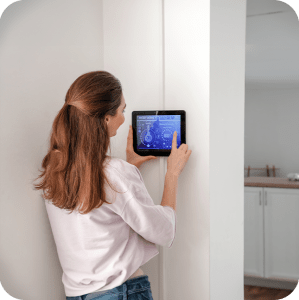
Transform your home or office into a connected ecosystem with intelligent sensors and controllers that work together seamlessly.

Automate HVAC, lighting, and occupancy management to reduce costs and create comfortable, energy-efficient environments.

Equip your robotic devices with the sensors they need to perform tasks autonomously, driving productivity and innovation to new heights.
Please reach out to us at: sales@embeddedworks.net if you have any additional questions that are not addressed below.
LoRaWAN® (Long Range Wide Area Network) is a wireless communication protocol built specifically for IoT devices that need to send small amounts of data over long distances while using very little power. Unlike Wi-Fi or Bluetooth, which are designed for high-speed, short-range connections, LoRaWAN operates in the sub-GHz frequency bands—enabling devices to communicate across kilometers on a single battery for years. It’s the ideal technology for low-maintenance, wide-area sensor networks.
LoRaWAN is built on open standards, allowing any compatible device—regardless of brand or network operator—to connect seamlessly. This interoperability lets businesses combine sensors, gateways, and network servers from multiple vendors under one unified platform.
A LoRaWAN network acts as the foundation for centralized device management and monitoring. You can onboard, control, and analyze data from all connected sensors in one dashboard—enabling scalable deployments, streamlined maintenance, and vendor flexibility for future growth.
Under optimal conditions, LoRaWAN sensors can reach distances of up to 10 kilometers in rural or open environments. In dense urban areas with obstacles, typical range spans several kilometers—more than enough to cover entire campuses, industrial parks, or city blocks with a single gateway.
A pre-provisioned gateway comes ready to deploy—security keys, network settings, and server integrations are preloaded, so your sensors can connect instantly. You can power it up, connect to the internet, and start collecting data within minutes.
A non-provisioned gateway, on the other hand, requires manual setup: configuring credentials, network links, and integrations yourself. This adds complexity, setup time, and potential for errors.
Pre-provisioned gateways eliminate this friction—offering faster deployment, enhanced security, and immediate scalability without the hassle of backend configuration.
LoRaWAN sensors are engineered for ultra-low power consumption. Depending on how often they transmit data, most can operate 5–10 years on a single lithium battery. The actual lifespan depends on sensor type, reporting interval, and environmental conditions—but LoRaWAN’s energy-efficient design makes it ideal for remote or hard-to-reach installations where frequent maintenance isn’t practical.
LoRaWAN employs AES-128 encryption for both network and application layers, ensuring data is secure from end to end. Each device is assigned unique encryption keys—one for network communication (NwkSKey) and another for application data (AppSKey)—so no intermediary, including gateways, can read your payloads.
Additionally, device authentication and identity management prevent unauthorized access. Gateways act as secure relays, forwarding encrypted data to the cloud without ever decrypting it. This layered approach keeps transmissions protected across public, private, or hybrid infrastructures.
Yes. LoRaWAN is an open and interoperable standard, meaning you can mix and match sensors, gateways, and network components from different vendors. As long as they follow the LoRaWAN protocol, they’ll communicate seamlessly through your chosen network server or IoT platform.
LoRaWAN is best suited for low-bandwidth, wide-area monitoring applications, such as:
Environmental and climate monitoring (temperature, humidity, air quality)
Predictive maintenance (vibration, pressure, motion)
Utility and energy metering (water, gas, electricity)
Smart agriculture and irrigation
Building and asset management in large facilities
It’s the go-to choice wherever you need broad coverage, long battery life, and low-cost connectivity.
A single LoRaWAN gateway can typically manage hundreds to thousands of connected devices—depending on how frequently each one transmits data. This “star-of-stars” architecture makes LoRaWAN highly scalable for dense sensor networks across campuses or cities.
No. LoRaWAN uses sub-GHz frequencies that can penetrate walls and obstacles, allowing sensors to send data to the nearest gateway even without clear line-of-sight. The gateway then relays that encrypted data to your network server for processing—no device-to-device routing or mesh networking required.
Deployment is simple: power up your pre-provisioned gateway, use OTAA (Over-The-Air Activation) to onboard your sensors, and they’ll automatically register to your network.
From there, you can manage all devices remotely through the SensorWorks platform—adjusting transmission rates, sleep intervals, or thresholds as needed. The network’s Adaptive Data Rate (ADR) automatically optimizes communication to balance range and battery life.
This streamlined process removes the need for manual configuration, coding, or complex integrations—so you can go from pilot to production faster.
Yes. You can remotely change parameters such as reporting intervals, trigger thresholds, or sensor modes directly from your platform dashboard. The SensorWorks portal handles all technical details—including payload formatting and downlink communication—so you can reconfigure devices without any coding or physical access.
Gateways connect to the internet via Ethernet, Cellular, or Wi-Fi, securely forwarding sensor data to a LoRaWAN Network Server (LNS), which then integrates with your IoT platform.
If you’re using a pre-provisioned gateway, this connection is already established—no additional setup is needed. If not, you’ll need to manually configure credentials and server links. Pre-provisioned gateways greatly simplify rollout, enabling you to scale from a single site to multiple locations quickly.
Most LoRaWAN sensors transmit data in real time and don’t act as storage devices. However, some models include limited buffer memory to store readings temporarily during network outages, forwarding them once connectivity resumes. Data processing and organization are handled by your IoT platform, ensuring consistent data integrity across your deployment.
Being network agnostic means your devices and gateways aren’t tied to any single LoRaWAN provider—you can connect to public, private, or hybrid networks based on your needs.
Popular supported network servers include The Things Stack, ChirpStack, and Actility ThingPark. This flexibility ensures you can scale globally, comply with regional regulations, and retain full control of your data routing and infrastructure costs.
SensorWorks uses OpenID Connect (OIDC) and SAML 2.0 authentication protocols to ensure only authorized users and systems can access your IoT data.
These frameworks enable single sign-on, encrypted tokens, and identity verification for all user and API interactions—protecting your devices, dashboards, and integrations. Combined with TLS encryption and strict role-based access control, your data remains secure from end to end without compromising usability.
Each device is registered with a unique identity (DevEUI and AppEUI). During the join process, the network automatically generates secure AppSKey and NwkSKey encryption keys for every sensor.
Gateways relay encrypted packets to the SensorWorks cloud using secure TLS/SSL tunnels, where data is decoded and presented for monitoring and analytics. All provisioning, key management, and updates are automated—ensuring your entire deployment remains compliant and secure without manual configuration.
LoRaWAN bridges can connect wirelessly collected sensor data to industrial systems via RS-485/Modbus, digital inputs (DI), and digital outputs (DO). This allows LoRaWAN networks to integrate with PLCs, HVAC controls, metering systems, or legacy automation equipment—bridging modern IoT technology with existing infrastructure.
Whether modernizing a factory, retrofitting a commercial building, or connecting a distributed sensor network, these bridges provide flexibility, scalability, and interoperability for future expansion.
Contact us today to explore how our mixed wireless IoT sensor solutions can optimize your operations, reduce costs, and open new possibilities across your organization. Join Embedded Works—your partner in driving the next generation of connected intelligence.